An introduction to psychology course is the best first step if you want to understand why people think, feel, and act the way they do. It gives you the big ideas of the field in a clear order. However, not every course delivers that well. Some are far too long, and others are too academic for beginners.
In this guide, we explain what a good introduction to psychology course covers and who it suits. We also show you how to choose one and how to get the most from it. Finally, we introduce our own program, Introduction to Psychology: Fundamental Psychology, built by the Institute of Professional Psychology for complete beginners.
Quick Answer: A complete introduction to psychology course covers the science of the mind, the brain, learning, memory, personality, and stress. Our 20-lecture program teaches all of these in about 90 minutes and needs no background in psychology.
In This Guide, You Will Learn:
- What an introduction to psychology course is and why it matters
- Which topics a complete beginner course must cover
- What our 20-lecture course teaches, section by section
- How to pick the right course and finish it
What Is an Introduction to Psychology Course?
An introduction to psychology course is a beginner-level program that surveys the whole field. It does not dive deep into one specialty. Instead, it gives you a map of the main ideas, methods, and research findings.
Psychology is also a young science. According to Wikipedia’s account of Wilhelm Wundt, he opened the first laboratory devoted exclusively to psychological studies at the University of Leipzig in 1879. Since then, researchers have tested ideas about attention, memory, and behavior through experiments. A good course teaches you what those experiments found. It also teaches you how to judge them.
Most introductory courses share three goals:
- Build your psychology vocabulary
- Teach you how to read research critically
- Connect each idea to everyday life
Why Study Psychology Before Anything Else?
Psychology helps in daily life. It explains habits, memory slips, stress reactions, and pressure from groups. As a result, it can improve how you study, work, and relate to others.
The field also shows strong demand. The U.S. Bureau of Labor Statistics projects that employment of psychologists will grow 6 percent from 2025 to 2035, compared with 3 percent for all occupations. It also reports a median annual wage of $99,110 for psychologists in May 2025. These figures describe licensed psychologists, not course graduates. Still, they show lasting demand for people who understand behavior.
An introductory course also helps you decide. You can test your interest before you commit to a degree or a specialty.
What a Complete Introduction to Psychology Course Should Cover
Course titles vary, yet the core topics are consistent. Use the table below as a quick checklist.
| Topic Area | Core Ideas | Everyday Payoff |
|---|---|---|
| The Science of Psychology | Research methods, ethics, landmark experiments | Spot weak studies and viral myths |
| Brain and Perception | Neuroplasticity, perception, attention, sleep, habits | Understand blind spots and build skills |
| Learning | Classical and operant conditioning | Explain habits and the pull of rewards |
| Memory and Thinking | Memory reconstruction, fast and slow thinking, intelligence testing | Study smarter and decide better |
| Personality | The Big Five traits | Describe people more accurately |
| Social Behavior and Stress | Conformity, motivation, effects of stress | Resist pressure and protect your wellbeing |
If a course skips research methods or ethics, treat that as a warning sign. Those two topics protect you from believing weak claims.
Our Introduction to Psychology Course at a Glance
If you want a short, clear start, begin with our Introduction to Psychology: Fundamental Psychology course. We designed it for people who want real understanding without a forty-hour commitment. Every lesson is brief, practical, and grounded in published research.
What You Get:
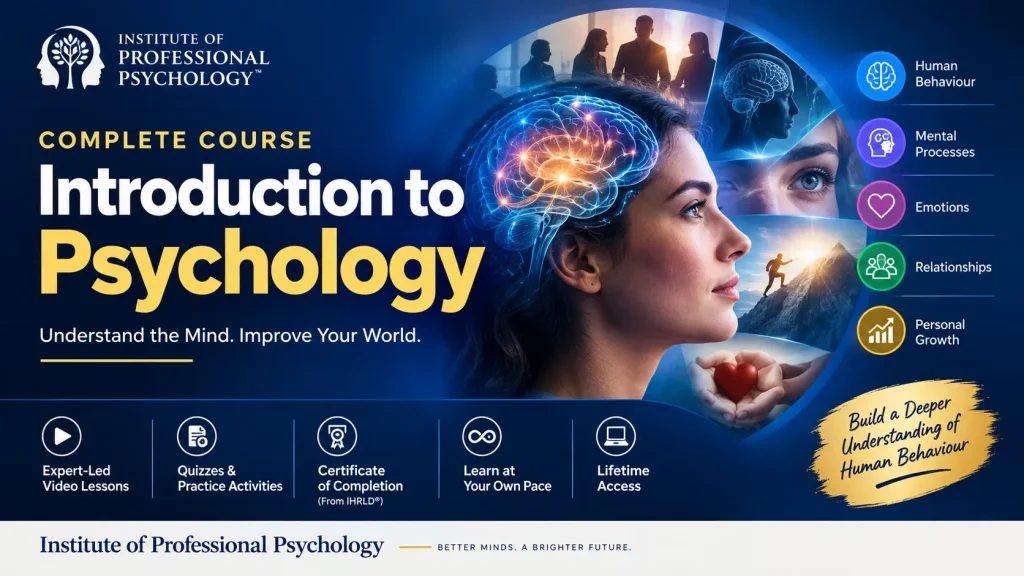
- 20 video lectures in 4 sections, about 90 minutes in total
- Plain-English lessons for complete beginners
- Downloadable resource files to review after each lesson
- Lifetime access on desktop, mobile, or tablet
- A Udemy certificate of completion, plus an independent Institute of Professional Psychology certificate
Please note what this course is and is not. It is an introduction to the field. It does not replace a degree or a license, and it does not qualify you to practice as a psychologist or therapist.
Enroll in Introduction to Psychology: Fundamental Psychology
Inside Our Introduction to Psychology Course Curriculum
The course has four sections. Each one builds on the one before it.
| Section | Lectures | Length | Key Topics |
|---|---|---|---|
| 1. The Science of the Mind | 5 | 23 min | How psychology moved from philosophy to science, how to read a study, the experiments that shaped ethical rules |
| 2. Brain, Perception, and Consciousness | 5 | 21 min | Neuroplasticity, how perception is built, the invisible gorilla, the sleeping brain, habits and autopilot |
| 3. Learning, Memory, and Thinking | 5 | 22 min | Conditioning, unpredictable rewards, memory as a rebuild, fast and slow thinking, what intelligence tests measure |
| 4. Personality, People, and Wellbeing | 5 | 22 min | The Big Five traits, conformity, how external rewards affect motivation, stress, where psychology goes next |
No prior knowledge is needed. You only need basic English, a curious mind, and a notebook for your own observations.
Three Ideas That Surprise Most Beginners
Learners often say a few lessons changed how they see everyday life. Here are three of them.
- Memory Is Rebuilt, Not Replayed. You do not store events like a video file. Instead, your brain reconstructs them each time you recall them. Therefore, confident memories can still be wrong.
- Attention Has Blind Spots. In the famous gorilla experiment, viewers who counted basketball passes often missed a person in a gorilla suit. Your attention is powerful, but it is also narrow.
- Stress Reaches the Body. The National Institute of Mental Health explains that long-term stress can affect your sleep and your immune, digestive, and cardiovascular systems. Knowing this makes stress easier to take seriously.
Who Should Take an Introduction to Psychology Course?
This type of course suits many learners. For example, it helps:
- Students who want to test their interest before choosing a major
- Managers and HR Professionals who want to understand motivation and teamwork
- Teachers and Parents who want to understand how people learn
- Writers, Coaches, and Creators who need a sound base in human behavior
- Curious Adults who simply want to understand themselves better
If your goal is clinical practice, remember that you will also need a degree, supervised training, and a license where you live.
How to Choose the Right Introduction to Psychology Course
Use this checklist before you enroll in any course:
- Clear Scope: The course lists its sections and lectures openly.
- Research Skills: It teaches you how to read and question studies.
- Sensible Length: It is short enough that you will actually finish it.
- Practical Examples: Each idea links to real situations.
- Honest Claims: It states plainly what its certificate does and does not mean.
- Recent Updates: The instructor keeps the content current.
5 Tips to Get the Most From Your Course
- Schedule Short Sessions. Watch two or three lectures a day, so the ideas stay fresh.
- Take Notes by Hand. Writing helps you remember, and it keeps you engaged.
- Test Ideas on Yourself. After each lesson, look for one example in your own day.
- Review After a Week. Spaced review strengthens memory far more than a single viewing.
- Pick Your Next Topic. Notice which section interested you most, then study that area further.
Why Learners Choose the Institute of Professional Psychology
The Institute of Professional Psychology teaches practical, research-based psychology to learners around the world. Our students keep returning because we turn complex ideas into clear, usable lessons. You can browse our full range of psychology courses and certification programs on our website.
- 30,000+ Learners enrolled in our courses worldwide
- 3,000+ Reviews from our students
- 4.7+ Average Rating across our instructor profile
Curious how psychology explains success? Read our review of 12 Lessons from Shah Rukh Khan, where we apply these ideas to a real life.
Frequently Asked Questions
What Is an Introduction to Psychology Course?
It is a beginner program that covers the main areas of psychology. Typical topics include research methods, the brain, learning, memory, personality, and stress.
Is This Course Suitable for Complete Beginners?
Yes. Our course assumes no background in psychology. We explain every term in plain English and use everyday examples.
How Long Does the Course Take?
The video lectures total about 90 minutes. You can finish them in one weekend or spread them over a few weeks, because you keep lifetime access.
Will I Get a Certificate?
Yes. You receive a Udemy certificate of completion and an independent certificate from the Institute of Professional Psychology. Both show that you completed the course. Neither is a professional license.
Can This Course Make Me a Psychologist?
No. It gives you a strong foundation, but practicing psychology requires formal education, supervised training, and licensing in most countries.
How Much Does the Course Cost?
Udemy sets the price and often runs discounts. Check the current price on the course page before you enroll.
Conclusion
A strong introduction to psychology course gives you the basics of the mind in a short, clear form. It should teach the science, the main topics, and the habit of questioning claims. Our 20-lecture program does exactly that in about 90 minutes.
If you are ready to begin, enroll in Introduction to Psychology: Fundamental Psychology today. When you finish, you can go deeper with our guide to forensic psychology certification or explore more courses at the Institute of Professional Psychology.