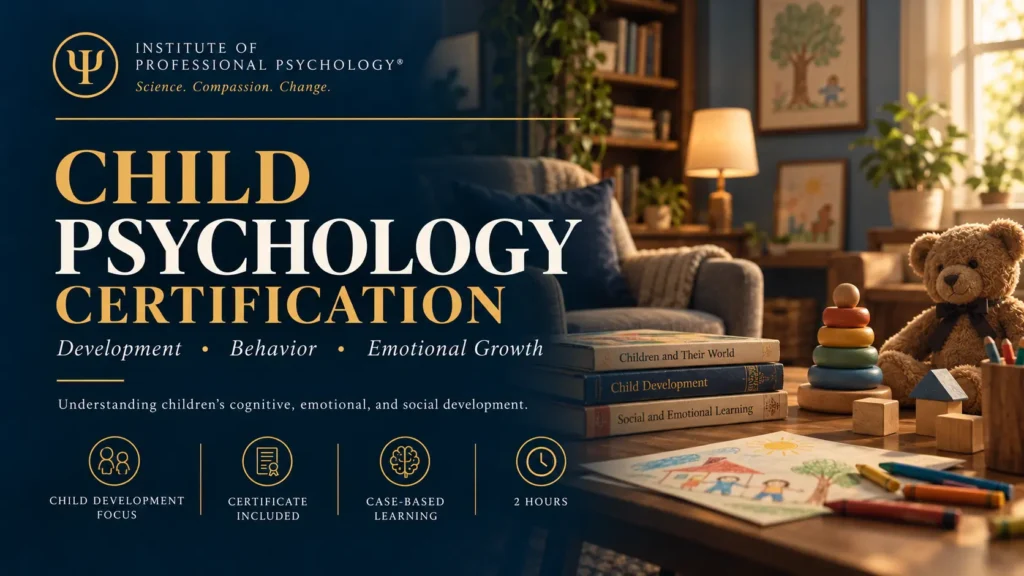
Quick answer: A child psychology certification is a short course that teaches how children develop, how childhood disorders show up, and which evidence-based interventions help. It is not a license, a degree or a treatment. It suits parents, teachers, counselors and students who want clear, structured knowledge. Our Clinical Child Psychology Certification Program covers 28 lectures in about 1 hour 51 minutes.
Children are not small adults. Their brains, emotions and behavior work differently at every age. That is why a child psychology certification can be so useful. It gives you a clear map of how children grow and what can go wrong. This guide explains what clinical child psychology is, how a certificate compares with a degree, and what you will learn in our course.
In This Guide, You Will Learn
- What child psychology certification means, and what it does not
- How a certificate differs from a child psychology degree
- Who benefits most from a clinical child psychology course
- The full curriculum of our 28-lecture program
- Which careers and next steps this knowledge supports
- How to choose a program you can trust
What Is Child Psychology Certification?
A child psychology certification is a structured course that ends in a certificate of completion. It teaches the core ideas of child and adolescent psychology. These include development, attachment, assessment and intervention.
Clinical child psychology is the part of psychology that studies mental health problems in children. It also studies how to assess and help them. The need is real. The World Health Organization reports that one in seven 10-19-year-olds experiences a mental disorder. Many of them go unnoticed for years.
Teachers, parents and counselors see children every day. A good child psychology certification helps them spot warning signs sooner and respond with more confidence.
Child Psychology Certification vs. Child Psychology Degree
Many people search for a child psychology degree first. A degree is the right path if you want to practice as a licensed psychologist. A certificate has a different job. It builds knowledge fast, and it costs far less time and money.
| Feature | Child Psychology Certification | Child Psychology Degree |
| Length | Hours to weeks | Several years |
| Main goal | Build knowledge and practical understanding | Prepare for professional training and licensure |
| Licensed practice | No | Usually part of a longer licensing route |
| Best for | Parents, teachers, counselors, early students | People who plan to practice clinically |
| Entry requirements | Usually none | Prior degrees and exams |
Licensing rules differ by country and state. The U.S. Bureau of Labor Statistics explains the typical education and licensing steps for psychologists in the United States. Check your local rules before you plan a career.
Our certificate does not replace that route. It can, however, give you a strong head start. It also shows you whether this field fits you before you commit to years of study. If you are comparing routes, our guide on how to become a forensic psychologist shows how a longer professional path works.
Who Should Take a Clinical Child Psychology Course?
You do not need a clinical background. The course is designed to be clear for beginners. At the same time, it adds depth for people who already work with children.
- Parents and family members who want to understand their child’s behavior
- Teachers and early childhood educators who see emotional and behavioral difficulties daily
- School counselors and school psychologists who want child-specific knowledge
- Graduate students in psychology, counseling or social work
- Child welfare and foster care professionals who support children in difficult placements
- Career changers who are exploring child mental health
New to psychology in general? Start with our Introduction to Psychology course. It builds the base that makes child psychology easier to follow.
What You Will Learn in Our Child Psychology Certification
Our Clinical Child Psychology Certification Program has five sections and 28 lectures. The total running time is about 1 hour 51 minutes. The lectures are short, so you can learn in small daily sessions.
| Section | Focus | Key Lectures |
| 1. Foundations | Development, brain and attachment | Why children are not small adults; developmental theory; neurodevelopment; attachment; the ecological model |
| 2. Psychopathology and Assessment | How disorders develop and how to assess them | Developmental psychopathology; ADHD; anxiety; childhood depression; accurate assessment; case formulation |
| 3. Evidence-Based Interventions | What helps children and families | Cognitive-behavioral therapy for children; Parent-Child Interaction Therapy; trauma-focused CBT; play therapy; school-based support |
| 4. Special Populations and Frontiers | Complex needs and new questions | Autism spectrum disorder; children in the welfare system; cultural competence; clinician well-being; screens and child mental health; the future of the field |
| 5. Bonus and Further Study | Book and course recommendations | Reading suggestions for therapists and counselors, and a closing thank-you lecture |
Foundations: Development, Brain and Attachment
The course starts with the basics. You learn why child psychology is a distinct science. You see how developmental theory changed our view of children’s minds. You also study the developing brain and the ecological model, which shows how family, school and community shape a child.
Attachment gets its own lecture. Attachment theory explains how early bonds shape later emotions and relationships. It is one of the most important ideas in the field.
Developmental Psychopathology and Assessment
Section 2 explains how problems start and grow. Developmental psychopathology looks at behavior in light of a child’s age and stage. You then study ADHD, childhood anxiety and childhood depression. You also learn the logic of reliable assessment and case formulation, which means seeing the whole child and not only the symptoms.
Evidence-Based Interventions
Section 3 introduces the main approaches used with children. These include cognitive-behavioral therapy adapted for children, Parent-Child Interaction Therapy, trauma-focused CBT and play therapy. It also covers school-based support. You learn what each approach does and where it fits.
Special Populations and Emerging Topics
Section 4 widens the lens. You explore autism spectrum disorder and the needs of children in the welfare system. You study cultural competence in child practice. The section also covers clinician burnout and the research on technology and screen time, with a clear view of myth versus evidence.
What This Child Psychology Certification Is and Is Not
We want you to know exactly what you are getting.
- It is an educational course with a certificate of completion.
- It is not a license, a degree or a clinical training placement.
- It does not qualify you to diagnose or treat children.
- If you are worried about a child, please contact a licensed professional.
The course also includes short promotional and book-recommendation lectures. These are separate from the teaching lessons. The course provides a Udemy completion certificate, and a lecture in Section 4 explains how to claim an additional certificate from the Institute of Professional Psychology.
Who Teaches It and What Learners Say
The program comes from Institute of Professional Psychology (IPP). Our courses have reached 30,000+ learners, with 3,000+ reviews and a 4.7+ instructor rating. We keep each lesson short and practical. We also design the course so beginners can follow it without a clinical background.
If you like our approach, you can also explore our forensic psychology certification. Want to build experience while you study? See our online psychology internship for students.
Careers and Next Steps After a Child Psychology Certification
A certificate alone does not lead to a license. It does, however, support many roles and next steps.
- Education: teaching, early childhood education and school support roles
- Child welfare: foster care, adoption and family support work
- Counseling: a stronger knowledge base as you pursue formal counseling training
- Further study: a strong preview before you apply to a degree program
- Parenting: clearer understanding of everyday behavior and emotions
How to Choose a Child Psychology Certification Program
Not every program is equal. Use these questions before you enroll.
- Is the curriculum visible? You should see every lecture title before you pay.
- Does it name its limits? Good programs say clearly that a certificate is not a license.
- Does it use evidence-based methods? Look for approaches with research support, such as CBT and PCIT.
- Is the length realistic? Short courses build awareness. They do not replace clinical training.
- Can you ask questions and read reviews? Real feedback tells you more than any sales page.
Frequently Asked Questions
What is a child psychology certification?
It is a course that ends in a certificate of completion. It teaches the basics of child development, childhood disorders and interventions. It is not a license or a degree.
Can I become a child psychologist with a certificate?
No. Becoming a licensed psychologist requires a degree and supervised training. Rules vary by country. A certificate can help you learn the field first.
Do I need a psychology background?
No. Our course requires no prior psychology or clinical background. You only need curiosity about child development.
How long does the course take?
The course has 28 lectures and runs about 1 hour 51 minutes. You can finish it in a few short sessions or spread it over a few weeks.
Is a child psychology certification worth it?
It is worth it if you want clear, structured knowledge fast. It suits parents, teachers and students. It is not worth it if you expect it to qualify you for clinical practice.
What is the difference between clinical child psychology and child psychology?
Child psychology studies how children think, feel and develop. Clinical child psychology focuses on mental health problems in children and how to assess and treat them.
Start Your Child Psychology Certification Today
Children do best when the adults around them understand them. A clear child psychology certification is a practical first step. In under two hours, you can learn how development works, how common disorders appear, and which approaches have research behind them.
Our course is a learning program only. It does not give you a license, and it does not replace therapy or professional care.
Enroll in the Clinical Child Psychology Certification Program
Prefer to explore first? Visit the Institute of Professional Psychology homepage to see all of our courses.