Forensic psychology certification can open the door to one of the most fascinating corners of applied psychology. It sits where human behavior meets the courtroom and the criminal justice system. However, the phrase confuses many learners. In this field, “certification” can mean a decade of doctoral training, or it can mean a focused online course.
In this guide, we explain what forensic psychology certification really means and which types exist. We also show who each type suits and how to start learning today, even without a psychology degree. Finally, we introduce our own Forensic & Criminal Psychology Certification Program (2026), built by the Institute of Professional Psychology for curious beginners and working professionals.
Quick Answer: Professional board certification in forensic psychology is reserved for licensed, doctoral-level psychologists. Everyone else can build solid foundations through an introductory forensic psychology certification program and earn a certificate of completion.
In This Guide, You Will Learn:
- What forensic psychology certification means in practice
- How certificates differ from licenses and degrees
- Which certification path fits your goals
- What a two-hour introductory program covers
What Is Forensic Psychology Certification?
Forensic psychology applies psychological science to legal questions. For example, specialists assess whether a defendant can stand trial, estimate the risk of violence, and explain memory research to a court. The U.S. Bureau of Labor Statistics notes that forensic psychologists partner with judges, lawyers, and other specialists to make sense of the psychological side of a case.
So, what is forensic psychology certification? It is a credential that shows you have met a defined standard of knowledge in this specialty. The standard, however, depends on who issues it. A professional board sets a high bar for licensed psychologists. An education provider sets a learning bar for students and professionals. Both are called certification, yet they mean very different things.
A credible forensic psychology certification should answer three questions:
- Who issues the credential?
- What must you complete to earn it?
- What does it allow you to do afterwards?
Forensic Psychology Certification vs. License vs. Degree
Before you choose a path, separate these four terms:
- Degree: An academic qualification from a college or university, such as a master’s or doctorate.
- License: Legal permission to practice psychology. According to the BLS, most U.S. states require a license to provide psychology services or to use the title “psychologist.”
- Board Certification: A voluntary specialty credential that licensed psychologists earn after years of experience.
- Course Certificate: Proof that you completed a structured training program. It does not grant a license.
The best-known specialty credential comes from the American Board of Professional Psychology (ABPP). Under its specialty requirements for forensic psychology, candidates need:
- A doctoral degree from an APA- or CPA-accredited professional psychology program, or an equivalent program, including an internship
- At least 100 hours of specialized forensic training after the doctorate
- Either 1,000 hours of forensic experience over at least five years, or a full-time postdoctoral program of at least 2,000 hours
Candidates also pass a credentials review and examinations. In short, ABPP-level forensic psychology certification is a career milestone for licensed doctoral-level psychologists, not a starting point.
Types of Forensic Psychology Certification
Learners generally meet three kinds of forensic psychology certification. The table below compares them.
| Type | Best For | Typical Entry Requirement | Time Needed | What You Receive |
|---|---|---|---|---|
| ABPP Board Certification | Licensed doctoral-level psychologists | Doctorate, license, supervised experience | Several years | Recognized specialist credential |
| University Graduate Certificate | Graduate students and justice professionals | Often a bachelor’s degree (varies by school) | Months to a year | Academic certificate |
| Online Professional Certificate | Beginners, students, writers, HR and security staff | None in most cases | Hours to weeks | Certificate of completion |
Each type serves a different goal. Board certification proves expert practice. University certificates add academic depth. Online programs, meanwhile, give flexible foundations, which is where most beginners should start.
Who Should Pursue Forensic Psychology Certification?
Forensic psychology certification suits anyone who wants a structured understanding of crime, courts, and behavior. For example, it helps:
- Psychology and Criminology Students who want a head start before graduate study
- Legal Professionals who work with expert witnesses, juries, or mental-state defenses
- HR and Investigation Staff who handle interviews, deception, and conduct cases
- Law Enforcement and Security Teams who need to understand behavior under pressure
- Writers and Filmmakers who want realistic, research-backed crime stories
- Aspiring Forensic Psychologists who want a first look before committing to years of study
If you fall into the last group, remember that the career itself requires a graduate degree and licensing in most regions.
5 Steps to Start Your Forensic Psychology Certification Journey
- Define Your Goal. Decide whether you want to become a licensed practitioner, work in a support role, or simply gain expert knowledge.
- Check Local Rules. Licensing and title laws differ by country and state, so read your regulator’s requirements first.
- Build Foundations. Begin with an introductory program to learn the core concepts and test your interest.
- Add Formal Study. If you plan to practice, prepare for a graduate degree and supervised experience.
- Join the Community. Organizations such as the American Psychology-Law Society offer job postings, resources, and a student committee.
Careers and Skills You Can Build
The wider psychology profession is growing. The BLS projects that employment of psychologists will rise 6 percent from 2025 to 2035, compared with 3 percent for all occupations. It also reports a median annual wage of $99,110 for psychologists in the United States in May 2025. These figures describe licensed psychologists overall, not course graduates. Still, they show steady demand for people who understand behavior.
Forensic knowledge also supports roles beyond clinical practice. Examples include victim advocacy, correctional support, investigations, compliance work, legal support, research, and writing. Requirements vary by country and employer, so always verify them locally.
Skills Worth Building:
- Thinking critically about evidence
- Spotting cognitive bias in yourself and others
- Reasoning through ethical dilemmas
- Writing clear, neutral reports
- Understanding legal ideas such as criminal intent
Start Your Forensic Psychology Certification With Our Program
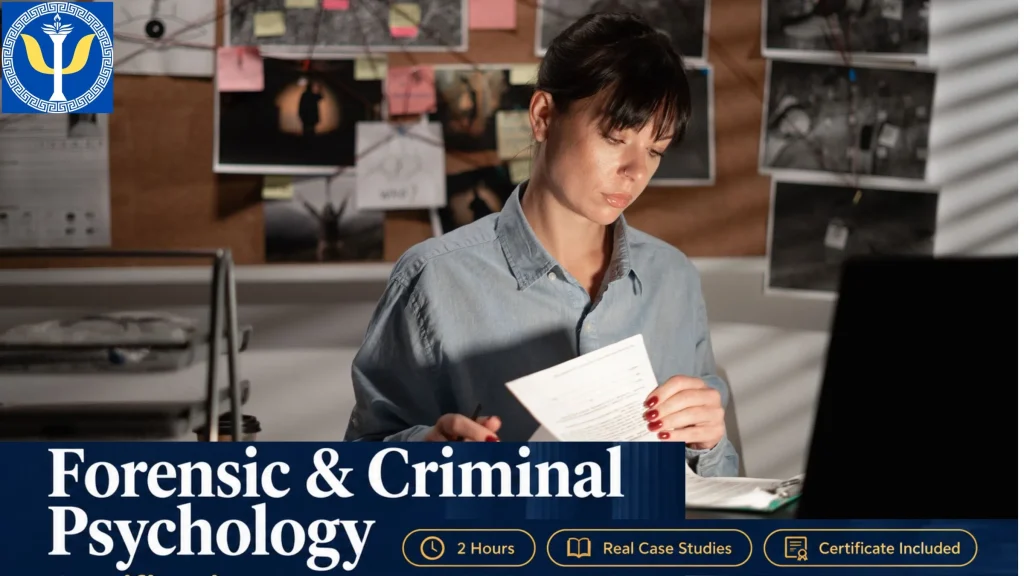
If you want a practical first step toward forensic psychology certification, begin with our Forensic & Criminal Psychology Certification Program (2026). We built it for learners who want real-world understanding without long, theory-heavy lectures. Each lesson turns courtroom concepts, criminal behavior research, and landmark cases into clear, practical ideas.
What You Get:
- About two hours of on-demand video across 27 lectures
- Three original case study articles on landmark forensic cases
- Downloadable, professionally branded resource files
- Quizzes, a capstone assignment, and a timed 50-question practice test
- Lifetime access on mobile, desktop, and TV, with closed captions
- A Udemy certificate of completion, plus a separate professional IPP certificate
Please note what this program is and is not. It is an introductory professional-development certificate. It does not replace a degree, a license, or ABPP board certification, and it does not qualify you to practice as a psychologist.
Enroll in the Forensic & Criminal Psychology Certification Program
What You Will Learn in Our Forensic Psychology Certification Course
The course runs across five focused sections and about two hours of video. Here is what each one covers:
| Section | Lectures | Length | Key Topics |
|---|---|---|---|
| 1. Foundations of Forensic Psychology and Legal Mental Frameworks | 6 | 30 min | What forensic psychology is, the criminal mind, crime typologies, criminal intent, the insanity defense |
| 2. Psychological Profiling Explained | 7 | 33 min | Profiling methods and limits, serial offender behavior, psychopathy versus antisocial personality, interrogation psychology, false confessions |
| 3. Courtroom Psychology, Decision-Making, and Expert Influence | 5 | 25 min | Competency to stand trial, jury psychology, eyewitness memory, violence risk assessment, expert testimony |
| 4. Modern Challenges, Ethics, and the Future of Forensic Psychology | 7 | 28 min | Juvenile offenders, mental illness in prisons, gender differences in crime, rehabilitation, AI and neuroscience |
| 5. Bonus Lectures and Study Plan | 2 | 4 min | Book recommendations and next steps |
No prior knowledge of psychology or law is required. You only need basic English, a curious mind, and a device to watch on.
Why Learners Choose the Institute of Professional Psychology
The Institute of Professional Psychology teaches practical, evidence-based psychology to learners around the world. Our students keep returning because we turn complex ideas into clear, usable lessons. You can explore the full range of our psychology courses and certification programs on our website.
- 2,300+ Students from more than 180 countries
- 700+ Reviews from learners
- 4.7 Instructor Rating on Udemy
Learners often praise the clear explanations, the downloadable resources, and the animated, AI-assisted presentation style. As a result, difficult topics feel easier to follow and remember.
How to Choose the Right Program
Use this checklist before you pay for any forensic psychology certification:
- Clear Labels: The provider states plainly whether the credential is a license, a board certification, or a course certificate.
- Relevant Syllabus: Look for legal concepts, profiling limits, courtroom psychology, and ethics.
- Evidence-Based Content: Good programs discuss myths and limitations, not only sensational cases.
- Practice Material: Quizzes, case studies, and assignments help you retain what you learn.
- Fresh Updates: Research and law evolve, so prefer programs that update their lessons regularly.
- Honest Reviews: Read recent reviews, and check how many learners have rated the course.
Frequently Asked Questions
What Is Forensic Psychology Certification?
It is a credential showing that you have met a set standard of knowledge in forensic psychology. The range is wide. It runs from ABPP board certification for licensed doctoral-level psychologists to online certificates of completion for learners.
Can I Earn Forensic Psychology Certification Online?
Yes, you can earn an online certificate of completion in forensic psychology. However, professional board certification cannot be earned through coursework alone. It requires a doctorate, a license, supervised experience, and examinations.
Do I Need a Degree to Start Learning Forensic Psychology?
No. Our program asks for no prior knowledge of psychology or law. A degree only becomes necessary if you want to practice as a psychologist.
Will This Program Make Me a Forensic Psychologist?
No. It gives you a strong, practical foundation and a certificate of completion. Becoming a forensic psychologist requires graduate education and licensing in most regions.
How Long Does the Course Take?
The course includes about two hours of video. You can finish it in a weekend or spread it over several weeks, because you keep lifetime access.
How Much Does the Course Cost?
Udemy sets the price and runs frequent discounts. Check the current price on the course page before you enroll.
Conclusion
Forensic psychology certification is not one single thing. Board certification marks the peak of a long professional journey. Course certificates, meanwhile, give you a fast and flexible way to understand crime, courts, and human behavior.
If you are ready to begin, our Forensic & Criminal Psychology Certification Program is a practical first step. It is clear, structured, and built for beginners. When you finish, explore more of our psychology courses at the Institute of Professional Psychology and keep building your expertise.